
Strobes AI Governance and Autonomy Controls
Overview
Strobes AI Penetration Testing provides configurable AI governance and autonomy controls to support different levels of engagement execution. This article explains the available execution types, autonomy modes, and workspace-level configuration options.
1. Execution Types in Strobes AI
Strobes workflows support different types of execution depending on the task.
Agent (AI)
Agent tasks are powered by Large Language Models (LLMs) and involve AI-driven decision-making.
Examples include:
- Test-case design
- Exploitation
- Triage
- Report writing
Strobes Task (Deterministic)
Strobes Tasks perform predefined scans or connector synchronizations without involving an AI model.
Example: Strobes CSPM (Prowler) cloud scan.
Command (Deterministic)
Commands execute pre-programmed shell commands on the workspace executor without involving an AI model.
Example: Port scanning of targets in the target list.
Execution Type Comparison
Execution Type | Description | Example |
|---|---|---|
Agent (AI) | An LLM-driven task involving AI judgment and decision-making. | Test-case design, exploitation, triage, report writing |
Strobes Task (Deterministic) | A scan or connector synchronization that runs without an AI model. | Strobes CSPM (Prowler) cloud scan |
Command (Deterministic) | A pre-programmed shell command executed on the workspace executor. | Port scan of targets |
2. Identifying Execution Types in the Product
The distinction between AI-driven and deterministic tasks is visible within the Strobes product.
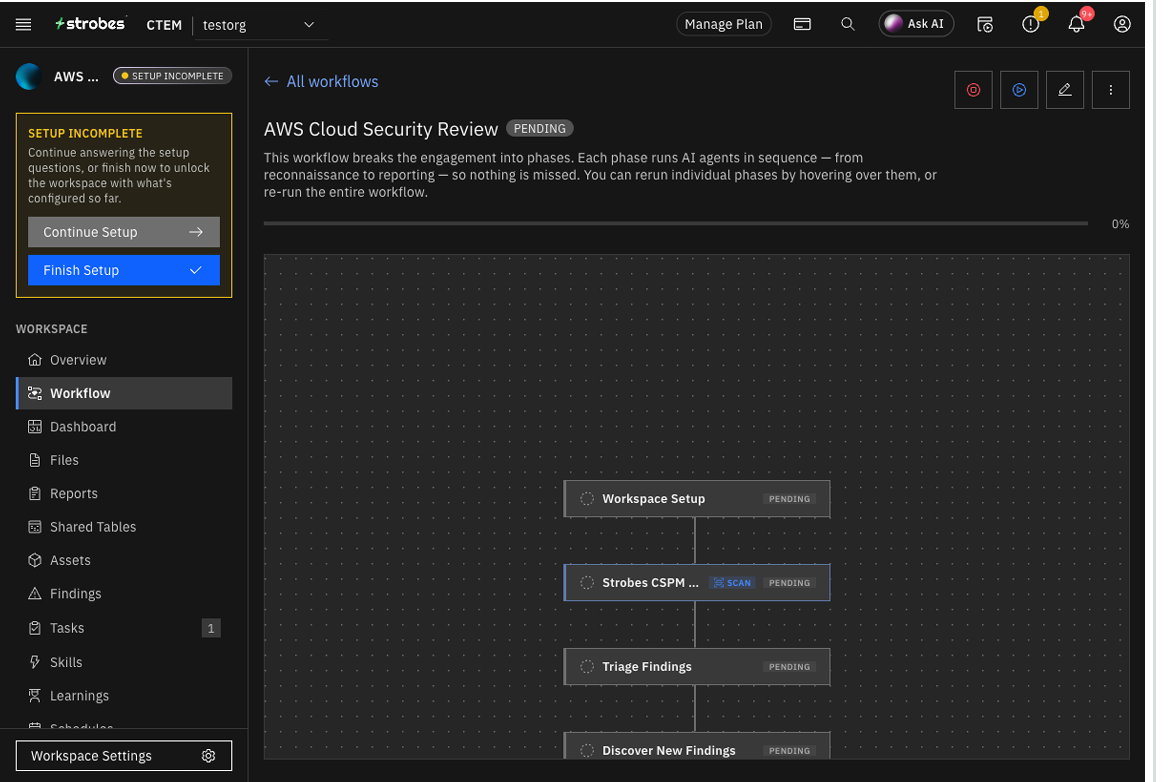
In the workflow view, deterministic scan or command steps display a distinct label.
For example, in an AWS Cloud Security Review workflow:
- Strobes CSPM carries a blue SCAN label, indicating a deterministic connector scan.
- Workspace Setup and Triage Findings run as agent steps.
Agent Tasks and Scans
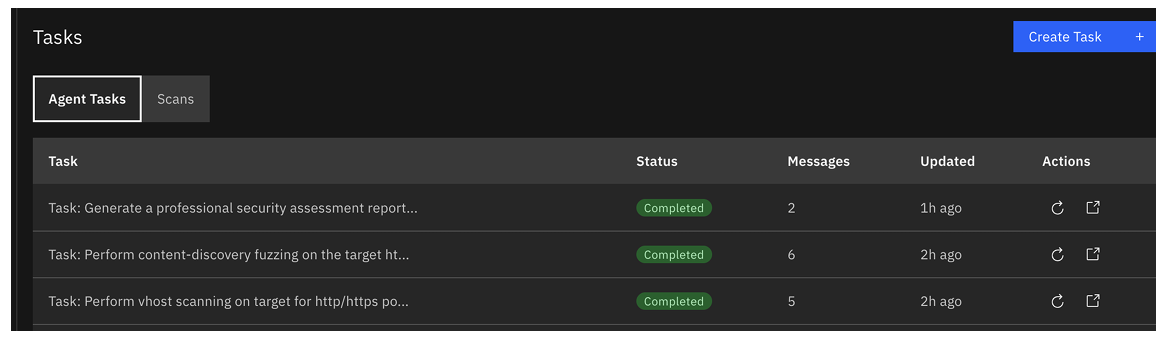
The workspace's Tasks page separates AI-driven tasks and deterministic scans into two tabs.
Agent Tasks
The Agent Tasks tab displays LLM-driven tasks along with their objectives, status, and message count.
Examples of agent task objectives include:
- Perform content-discovery fuzzing on the target.
- Perform vhost scanning.
- Other objective-driven security testing tasks.
Scans
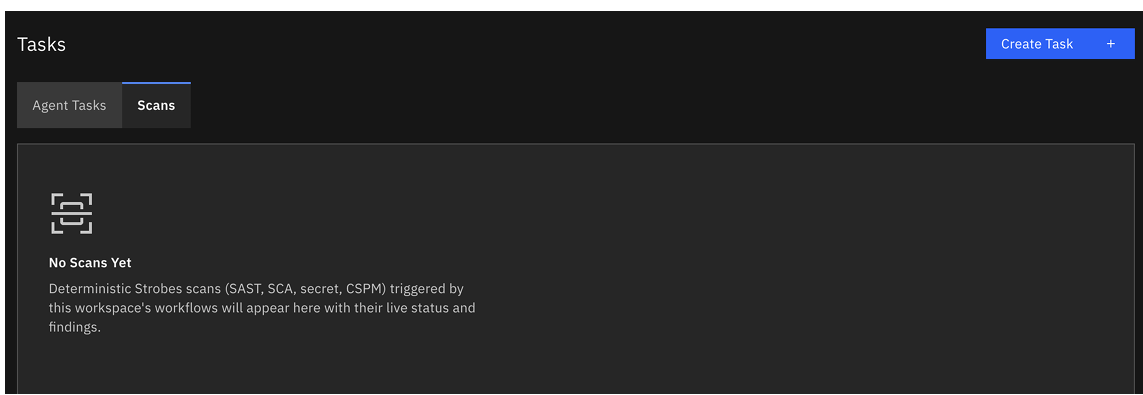
The Scans tab displays deterministic Strobes scans triggered by workspace workflows.
These include:
- SAST
- SCA
- Secret scanning
- CSPM
The tab also provides the live status and findings associated with these scans.
3. Autonomy Modes
Strobes supports different levels of autonomy, ranging from human-led delegated tasks to fully autonomous engagements.
Autonomy can be configured at the workspace level.
Human-in-the-Loop
In this mode, a user provides the agent with a specific objective. The agent executes the task and stops after completing the objective.
This mode is available through:
- Workspace Chat
- Create AI Task
Examples of delegated objectives include:
- Check a specific endpoint for BOLA.
- Validate a single finding.
- Triage a batch of findings.
This allows security teams to delegate specific tasks to an agent across multiple targets.
Autonomous Execution
In Autonomous mode, AI runs all phases of a workflow without pausing for approval at each step.
Workflow-backed playbooks can execute complete multi-phase security engagements.
Supported Autonomous Playbooks
Playbook | Number of Phases | Execution Description |
|---|---|---|
Web App Pentest | 13 | Full OWASP WSTG-aligned test-case design and execution loop |
Mobile App Pentest (Android) | 21 | OWASP MASVS-aligned static and dynamic testing with per-check verdicts |
AWS Cloud Security Review | 7 | Scan-first CSPM run, followed by triage, discovery, validation, and reporting |
Note: The playbooks listed above are examples of supported autonomous playbooks. Strobes supports additional autonomous playbooks, and this list may continue to expand as new playbooks are introduced.
4. Execution Mode Configuration
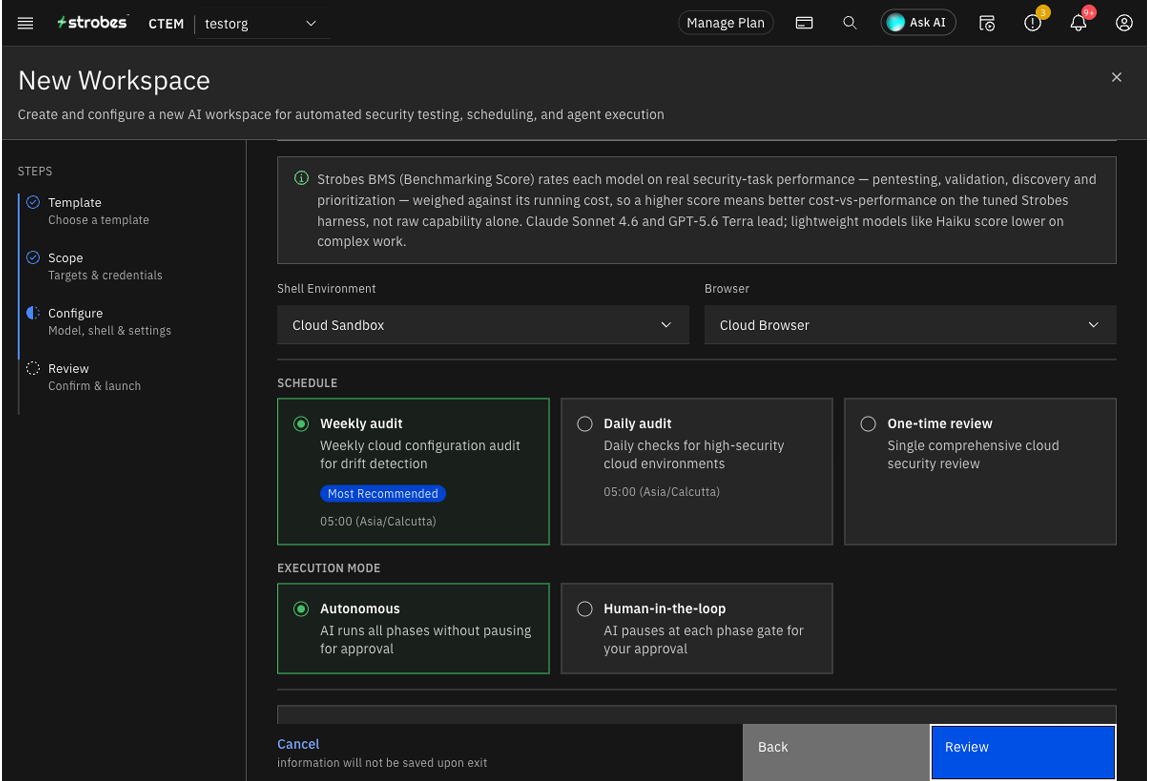
The Execution Mode setting allows users to configure how AI agents execute workflow phases.
The available options are:
Autonomous
AI runs all phases without pausing for approval.
Human-in-the-Loop
AI pauses at each phase for approval.
Execution Mode is configurable at the workspace level.
5. Scheduled Autonomous Engagements
Strobes supports unattended execution of engagements on a recurring basis.
For example, the AWS Cloud Security Review playbook provides scheduling options directly within the workspace setup wizard.
Available scheduling options include:
Schedule | Description |
|---|---|
Weekly Audit | Runs a weekly cloud configuration audit |
Daily Audit | Runs daily checks for cloud environment monitoring |
One-Time Review | Performs a single comprehensive cloud security review |
The schedule can be configured along with the Execution Mode.
6. Workspace Execution Configuration
Autonomy is controlled through the workspace's Execution Mode setting.
Users can configure the workspace to operate in either:
- Autonomous mode
- Human-in-the-Loop mode
This provides flexibility to choose the level of human involvement required for different security engagements.
Summary
Strobes AI Penetration Testing provides the following capabilities:
- AI-driven agent tasks.
- Deterministic scans and commands.
- Separate tracking of Agent Tasks and Scans.
- Human-in-the-Loop execution.
- Autonomous multi-phase engagements.
- Scheduled autonomous security reviews.
- Workspace-level Execution Mode configuration.
These capabilities allow organizations to choose the appropriate level of automation and human involvement for their security testing workflows.